
Best Practices and Improving Education Quality
How do we maintain high education quality at the Faculty of Computer Science?

 Supporting Educators' Engagement
Our educators participate in courses that enhance qualifications in modern teaching techniques (the Faculty has participated in two POWER projects). Annually, our lecturers and instructors are nominated for the AGH Didactic Laurel, the Rector's Teaching Award, and are also advisors for theses awarded in AGH Diamonds. Educational achievements are documented by all employees in a dedicated, centrally managed information system. This serves as the basis for applying for various awards at the university level.
We Listen to Our Students
Once a semester, we organize meetings with students, including members of the Student Representative Council, during which we discuss the contents of syllabi and educational programs. This allows us to understand the student perspective and gives student representatives a real influence on the course of their studies. The Vice Dean for Education, Marek Gajęcki, Ph.D. conducts training for class representatives in the first year on contacting students and conveying important educational information. This ensures continuous contact through selected representatives of the student community.
Students also actively participate in organizing enrollments for various laboratory groups, to adjust the hours of instruction we offer to their time preferences.
In matters related to exams, credits, or teaching, students are also supported by the Faculty Student Advisor for Educational Affairs.
We Develop Business Relationships
We maintain constant contact with business representatives - the Program Council of the AGH Faculty of Computer Science, industry associations such as the Polish Cybersecurity Cluster, and leading IT companies operating in Poland. The business environment supports us by consulting on selected changes in our educational programs, in order to maintain the graduate profile attractive to the job market. Thanks to contacts with industry organizations and companies, we also organize many free educational events for our students (including the Student Innovation Festival IT is ME, AGH Cyber Campus, lectures and workshops conducted by IT company specialists).
We Assess the Level of Education
Centralized surveys are conducted at the end of each semester's classes. Students evaluate each subject, form of classes, and all instructors with whom they had classes. The surveys are integrated and preliminarily processed by technical support and then sent to the University Team for Education Quality (UZJK) for the relevant discipline. The course coordinator from UZJK analyzes the survey results for any potential violations, such as syllabus entries.
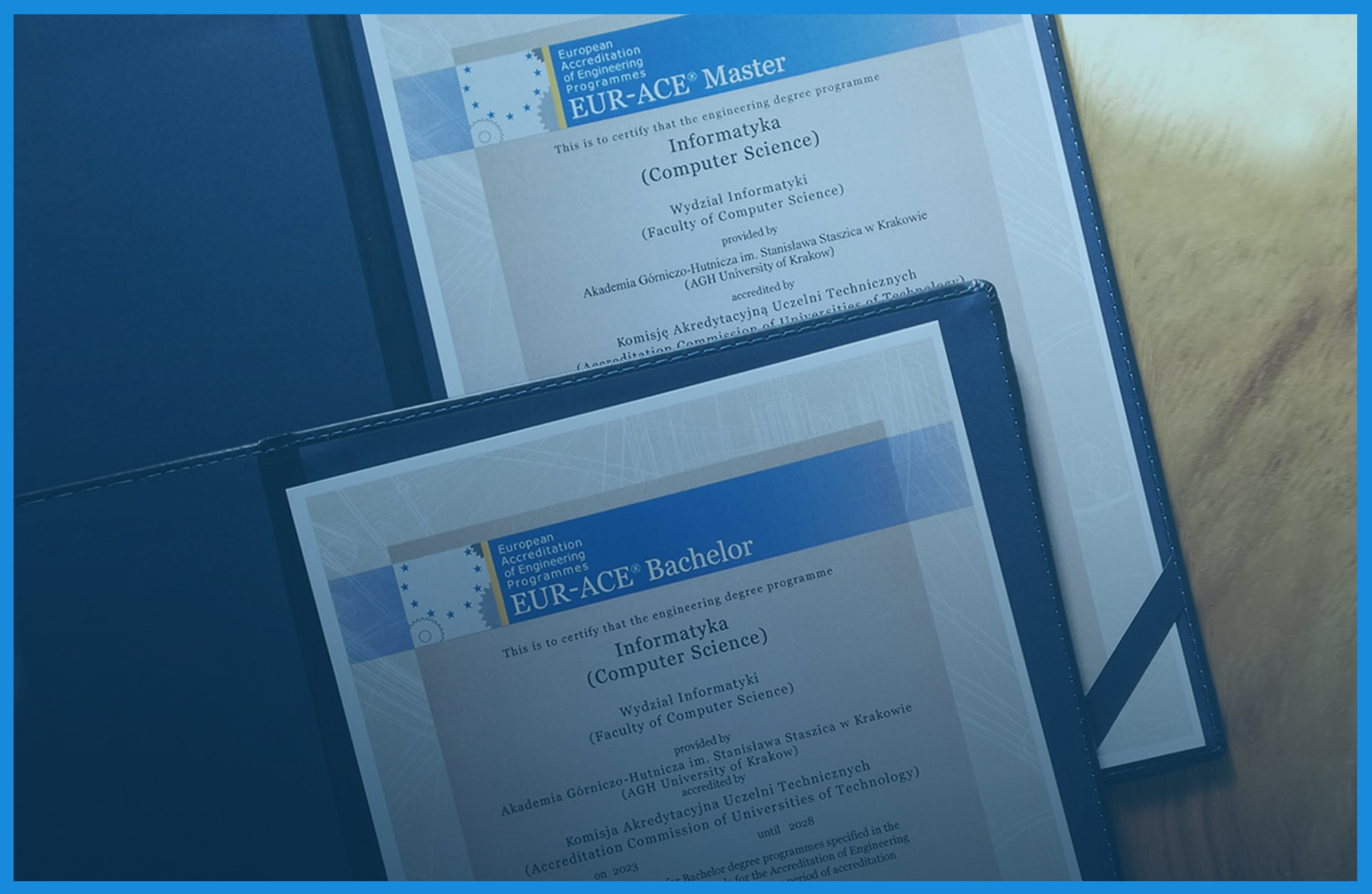
The University Accreditation Commission of Technical Universities (KAUT), established by the Conference of Rectors of Polish Technical Universities on February 17, 2001, is authorized to accredit programs of technical universities. The Commission consists of representatives from 25 universities.
The EUR-ACE® Label (European Accredited Engineer) is an accreditation program that confirms a high level and compliance with the norms and principles of quality in university-level education accepted in Europe. Thanks to the accreditation, the university gains confirmation of the high quality of engineering education and that the teaching is conducted according to the standards set by professional organizations. Students can be assured that programs with the EUR-ACE® Label meet international standards and are recognized by employers across Europe. Employers, in turn, are assured that the candidate’s competencies in terms of knowledge, understanding, and practical skills comply with international standards in engineering education.
2. PKA Evaluation
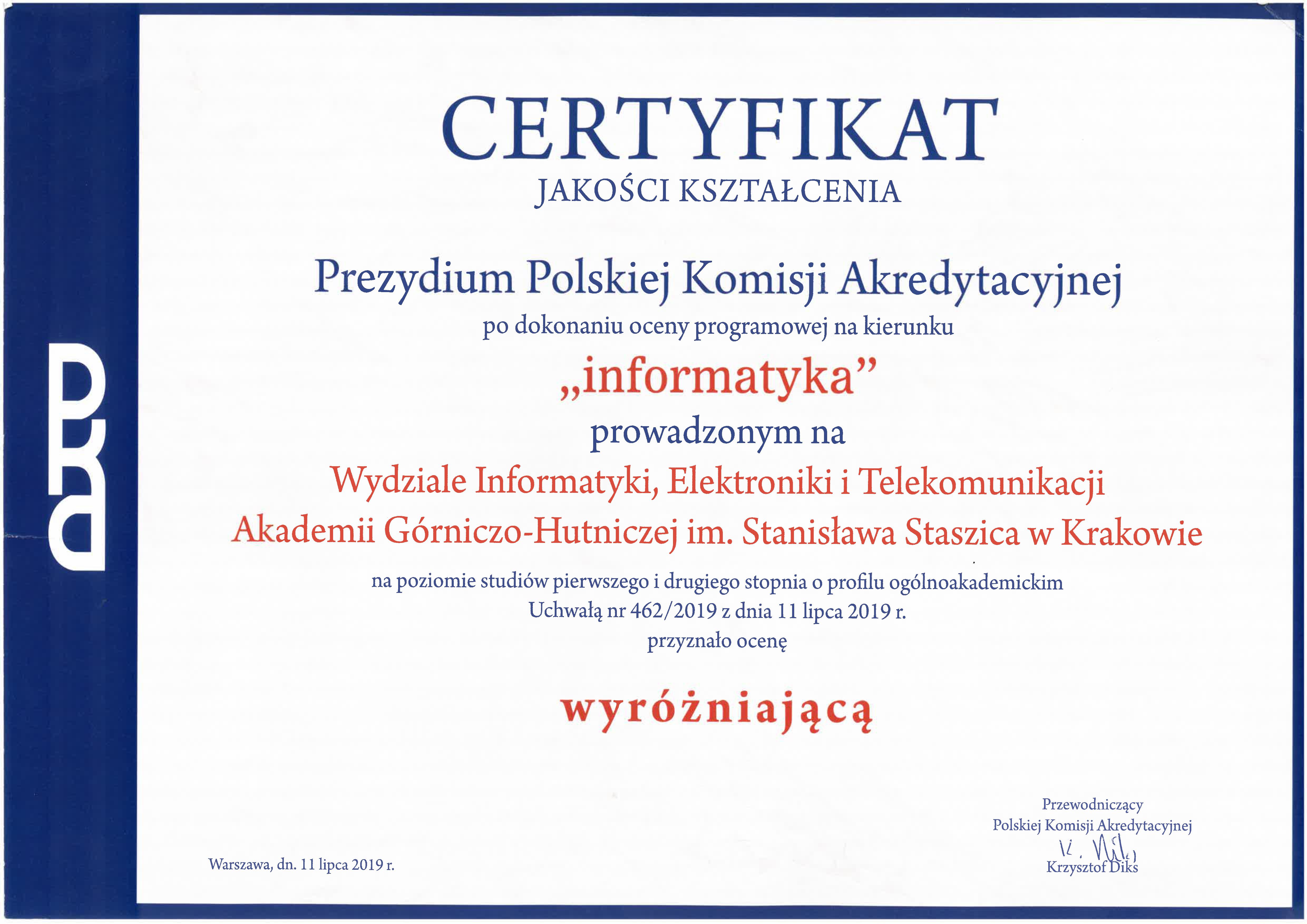
Outstanding Evaluation - Computer Science program (Bachelor's and Master's) – 2011, 2018, 2019
The Polish Accreditation Committee (PKA) is the first independent institution operating within the Polish higher education system aimed at improving the quality of education at all public and private universities within this system, authorized to assess the fulfillment of conditions for conducting education and its quality at undergraduate and graduate levels.
An outstanding evaluation is awarded to units distinguished by a high level and exemplary organization of their educational and scientific activities, good material resources, the scope and nature of international cooperation, an exceptional staff recognized nationally and internationally, offering students participation in international studies and programs, as well as creating conditions for the development of their scientific activity.
In 2021, our unit operated as the Institute of Computer Science within the Department of Computer Science, Electronics, and Telecommunications. The Department of Computer Science began its operations on October 1, 2023.
3. Scientific Category
Evaluation of the Quality of Research Activities for 2022–2025:
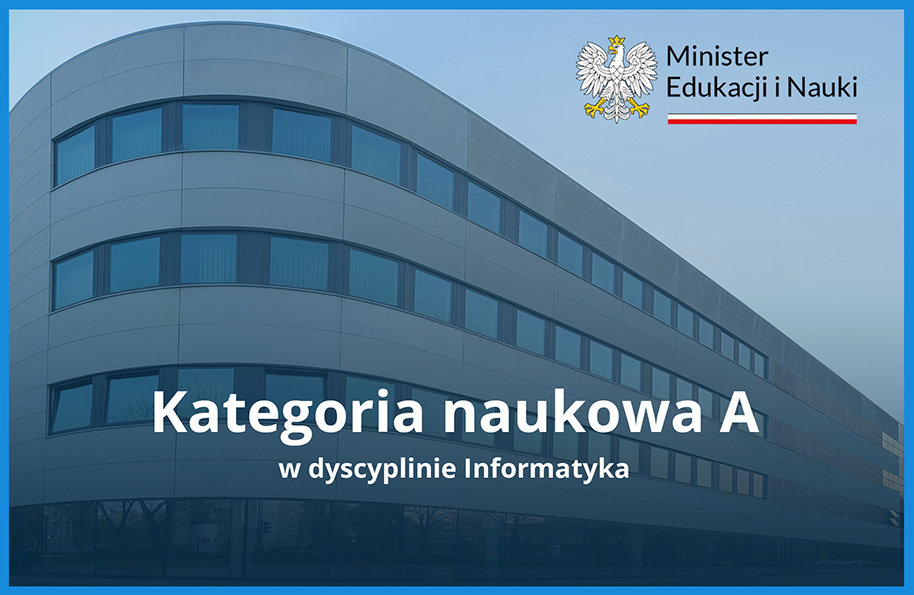
Scientific Category A+ – Discipline: Computer Science and Technical Computer Science and Telecommunications
Scientific Category A – Discipline: Computer Science and Technical Computer Science and Telecommunications – 2022
The mandatory evaluation of scientific activity is conducted by the Scientific Evaluation Committee and is ultimately approved by the minister. The results of the evaluation determine whether an institution will maintain/acquire the rights to offer degree programs, doctoral schools, and confer degrees and titles. The evaluation also affects the amount of subsidies received from the state budget.
The Scientific Evaluation Committee awards Category A (very good) to units representing a high level relative to international standards, based on the following criteria:
- • The scientific or artistic level of the conducted scientific activities;
- • Financial outcomes of scientific research and development work;
- • The impact of scientific activities on the functioning of society and the economy.
4. Ranking of Technical Studies “Perspectives”
1st place – Computer Science (M.Sc. Eng.) – 2019
2nd place - Computer Science (M.Sc. Eng.) – 2018, 2020, 2021, 2022, 2023, 2024, 2025, 2026
2nd place - Computer Science - Data Science (M.Sc.) and Computer Science - Machine Learning and Artificial Intelligence (M.Sc.) – 2026
The Study Programs Ranking provides organized information about the most popular study programs conducted at Polish academic institutions. Each year, 'Perspektywy' evaluates dozens of groups of study programs in several fields.
The consistently high yearly performance of the Computer Science program confirms the level and quality of education and modern educational facilities. The evaluation of programs considered the following criteria: prestige, graduates in the job market, academic potential, educational potential, scientific potential, internationalization, and additional criteria.
Selected teaching awards and honors
Medal of the National Education Commission
The Minister of Education awarded the Medal of the National Education Commission to outstanding teachers and university professors in recognition of their exceptional contributions to teaching.
2024
Ada Brzoza-Zajęcka, Ph.D., Eng.
Wojciech Czech, Ph.D., Eng.
Rafał Dreżewski, D.Sc. Eng., Prof. AGH
Joanna Kosińska, Ph.D., Eng.
Tomasz Pełech-Pilichowski, Ph.D., Eng.
Wojciech Zaborowski, Ph.D., Eng.
2023
prof. Aleksander Byrski, D.Sc. Eng.
prof. Grzegorz Dobrowolski, D.Sc. Eng.
prof. Robert Schaefer, D.Sc. Eng.
Maciej Malawski, D.Sc. Eng., prof. AGH
prof. Piotr Nawrocki, D.Sc. Eng.
prof. Maciej Paszyński, D.Sc.
Leszek Siwik, D.Sc. Eng.
Tomasz Szydło, D.Sc. Eng.
Bartłomiej Śnieżyński, D.Sc. Eng.
Wojciech Turek, D.Sc. Eng.
Łukasz Czekierda, Ph.D., Eng.
Jacek Dajda, Ph.D., Eng.
Robert Marcjan, Ph.D., Eng.
Katarzyna Rycerz, Ph.D., Eng.
Sławomir Zieliński, Ph.D., Eng.
Marek Konieczny, M.Sc., Eng.
AGH Diamonds
2025
Honorable Mentions
Category – Applied Theses
Piotr Ludynia (WI)
Thesis topic: “Easy and efficient computation of molecular fingerprints in Python”
Advisor: Wojciech Czech, Ph.D., Eng. (WI)
Category – Theoretical Theses
Piotr Urbańczyk (WI)
Thesis topic: “Multi-Hybrid Swarm Optimization”
Advisor: Prof. Aleksander Byrski, Ph.D., Eng. (WI)
2024
3rd place
Tomasz Lamża (WI)
Thesis topic: “Hyperparameter tuning for quantum combinatorial optimization algorithms”
Advisor: Dr. Eng. Katarzyna Rycerz (WI)
2023
2nd place
Szymon Mazurek (WEAIiB)
Thesis topic: “Epilepsy seizure detection and dynamical brain connectivity via machine learning”
Advisor: Dr. Eng. Maciej Malawski, Prof. AGH (WI)
Honorable Mentions
Wojciech Achtelik (WIEiT)
Thesis topic: “Analysis of tissue oxygenation data from near-infrared spectroscopy”
Advisor: Maciej Smołka, Ph.D., Eng., Prof. AGH (WI)
Wojciech Konieczkowicz (WIEiT)
Thesis topic: “Self-supervised learning for medical diagnosis and imaging”
Advisor: Prof. Bogdan Kwolek, Ph.D., Eng. (WI)
Julia Machnio (WEAIiB)
Thesis topic: “MRI data segmentation with deep learning using large-scale computing”
Advisors: Dr. Tomasz Pięciak (WEAIiB), Dr. Maciej Malawski, prof. AGH (WI)
Rector’s Teaching Awards for 2024
Kamil Piętak, Ph.D., Eng. – First Degree
Łukasz Czekierda, Ph.D., Eng., prof. AGH – First Degree
Paweł Topa, Ph.D., Eng., prof. AGH – Second Degree
Wojciech Czech, Ph.D., Eng. – Second Degree
Marek Konieczny, M.Sc. Eng. – Third Degree
Team Award for First-Degree Teaching Achievements for the creation of a new second-degree program in Computer Science – Machine Learning and Artificial Intelligence
Marek Gajęcki, Ph.D., Eng., Dr. Anna Zygmunt, Ph.D., Dr. Marcin Kurdziel, Ph.D., Prof. AGH, Dr. Paweł Gajewski, Dr. Wojciech Czech, Prof. Aleksander Byrski, Ph.D., M.Sc. Jakub Adamczyk, M.Sc. Kinga Grzesik-Staroń, M.Sc. Wiktoria Maternowska
AGH Teaching Award
Nominees for the 2024 edition
Michał Idzik, Ph.D., Eng. – in the Teaching Assistant category
Nominees for the 2023 edition
Prof. Krzysztof Boryczko, Ph.D., Eng. – in the Lecturer category
Katarzyna Rycerz, Ph.D., Eng. – in the Thesis Advisor category
Michał Idzik, M.S., Eng. – in the Teaching Assistant category
Individuals responsible for the quality of education at the Faculty of Computer Science:
Prof. Marek Kisiel-Dorohinicki, Ph.D., Eng. – Dean of the Faculty of Computer Science
Marek Gajęcki, Ph.D., Eng. – Vice Dean for Academic Affairs
Anna Zygmunt, Ph.D., Eng. – Dean’s Representative for Teaching
Prof. Piotr Nawrocki, Ph.D., Eng. – Dean’s Representative for Tuition-Based Education
Łukasz Czekierda, Ph.D., Eng. – Dean’s Representative for Graduation
Paweł Topa, Ph.D., Eng. – Dean’s Representative for Cybersecurity
Council for Educational Quality in the Field of Technical Informatics and Telecommunications (link)
Piotr Kowalski, Ph.D., Eng., Prof. at AGH (WFiIS) – Education Quality Coordinator
Krzysztof Banaś, Ph.D., Eng., Prof. at AGH (WIMiIP) – Representative of the Technical Informatics program (WIMiIP)
Gabriel Rojek, Ph.D., Eng. (WIMiIP) – representative of the Computational Engineering program (WIMiIP)
Krzysztof Kluza, Ph.D., Eng. (WEAIiIB) – representative of the Computer Science program (WEAIiIB)
Jędrzej Byrski, Ph.D., Eng. (WEAIiIB) – representative of the Computer Science and Intelligent Systems program (WEAIiIB)
Marcin Niemiec, Ph.D., Eng., Prof. AGH (WIEiT) – representative of the Cybersecurity program (WIEiT)
Paweł Kułakowski, Ph.D., Eng., Prof. AGH (WIEiT) – representative of the Telecommunications and Information Technology program (WIEiT)
Krzysztof Grochot, Ph.D. (WIEiT) – representative of the Modern Technologies in Forensics program (WIEiT, WH, WIMiC)
Anna Zygmunt, Ph.D., Eng., Prof. AGH (WI) - representative of the Computer Science program (WEAIiIB, WI)
Tomasz Służalec, Ph.D., Eng. (WI) – representative of the Computer Science – Data Science program (WI)
Paweł Topa, Ph.D., Eng., Prof. AGH (WI) – representative of the Computer Science – Information Security Management program (WI)
Marcin Kurdziel, Ph.D., Eng., Prof. AGH (WI) – representative of the Computer Science – Machine Learning and Artificial Intelligence program (WI)
Małgorzata Krawczyk, Ph.D., Eng., Prof. AGH (WFiIS) – representative of the Applied Computer Science program (WFiIS)
Krzysztof Boryczko, Ph.D., Eng., Prof. AGH (WI) – Virtual Space and Game Development (WI & WH)
Jakub Kaliński - student representative

Rector’s Orders
• Rector’s Order No. 66/2025 on the rules and procedures for conducting surveys. (link)
• Rector’s Order No. 63/2025 on detailed rules for the establishment, transformation, and abolition of first- and second-cycle degree programs in a specific field of study, level, and profile. (link)
• Rector’s Order No. 4/2026 on the detailed rules for establishing, transforming, and abolishing uniform master’s degree programs in a specific field of study and profile. (link)
• Rector’s Order No. 12/2026 on the University Quality Assurance System at the Stanisław Staszic University of Science and Technology in Kraków. (link)
• Rector’s Order No. 17/2022 amending Order No. 43/2020 on the size of student groups. (link)
Senate Resolutions
• Senate Resolution 102/2025 on guidelines for establishing first- and second-cycle study programs at the Stanisław Staszic University of Science and Technology in Kraków. (link)
• Uchwała Senatu 103/2025 w sprawie w sprawie wytycznych w zakresie ustalania programów jednolitych studiów magisterskich w Akademii Górniczo-Hutniczej im. Stanisława Staszica w KrakowieSenate Resolution 103/2025 on guidelines for establishing uniform master’s degree programs at the Stanisław Staszic University of Science and Technology in Kraków. (link)