
The European Master for High Performance Computing (EUMaster4HPC) will develop its programme with an additional focus on artificial intelligence and quantum computing, starting in September 2026. Faculty of Computer Science is joining as a core academic partner of the EUMaster4HPC consortium, with Łukasz Czekierda as a projects coordinator. In total, 43 partners from 23 countries, coordinated by the University of Luxembourg, are playing a key role in shaping the digital future of the continent.
After successfully recruiting over 100 students during its four-year pilot phase, EUMaster4HPC will train 400 students in Europe over the next six years. Applications for the next cohort are open until 15 August 2026. EUMaster4HPC is funded by the EuroHPC Joint Undertaking, a European Union public-private partnership, with an overall budget of €10 million.
These additions address Europe’s growing need for experts at the intersection of HPC and emerging technologies, equipping students to advance the adoption of exascale computing in industry and society. As artificial intelligence and quantum computing rapidly reshape the computational landscape, the programme ensures that graduates are prepared not only with advanced technical expertise but also with the skills to navigate, innovate, and lead in these transformative fields.
This unique Master’s programme will continue to emphasise interdisciplinarity and cross-border collaboration and will provide national and European students with a world-class education that will serve industry and society at large, fostering highly sought-after expertise in advanced computing. Through this international mobility, students will earn a double degree from the two universities where they studied, gaining broad international experience and exposure to diverse HPC environments. Whether at a partner university, a research centre, a supercomputing centre, or in the industry, they will focus on real-world challenges such as climate modelling, bioinformatics, aerospace engineering, materials science, and financial simulation.
 The EUMaster4HPC consortium will extend the number of awarding universities through open calls, therefore strengthening the European HPC ecosystem, by training the next generation of HPC, AI and quantum computing experts.
– says Prof. Marko Rančić, Associate Professor in High Performance and Quantum Computing at the University of Luxembourg.
Becoming a core academic partner of EUMaster4HPC is an important milestone for our Faculty and confirms our position as a trusted contributor to European excellence in advanced computing education. We are proud to help shape a programme that combines scientific excellence, international mobility, and close collaboration with industry to prepare specialists for the technologies that will define the
future.
– adds prof. Łukasz Czekierda, programme coordinator.
Graduates of the EUMaster4HPC programme gain advanced expertise and a strong professional network as part of the European HPC community. This opens direct pathways to careers in leading supercomputing centres, research centres, and industry, while nearly half of graduates continue their academic journey with a PhD. Building on this strong track record, the programme is currently accepting applications for its next cohort.
Undergraduate students from all technical disciplines in science, technology, engineering, and mathematics, with strong programming skills, can apply on eumaster4hpc.eu until 15 August 2026, for admission in September 2026 in 8 universities of their choice (AGH University of Krakow will be available from 2027 only).
About the EUMaster4HPC:
The consortium brings together 43 partners over 23 countries, including leading universities, research centres, supercomputing centres, and industrial and SME partners. Together, they contribute to both foundational and specialised HPC training modules, research-led teaching, and hands-on learning opportunities.
With an overall budget of 10 million euros, EUMaster4HPC is funded by the EuroHPC Joint Undertaking, a European Union public-private partnership established in 2018 to coordinate the efforts and pool the resources of EU member states and participating countries, with the goal of making Europe a global leader in supercomputing. Building on this support, the EUMaster4HPC aims not only to advance educational excellence but also to reinforce European digital sovereignty, strengthen a resilient and competitive HPC workforce, and align with national and European strategies in artificial intelligence, quantum computing, and advanced scientific infrastructures. More information: eumaster4hpc.eu
Degree awarding Universities:
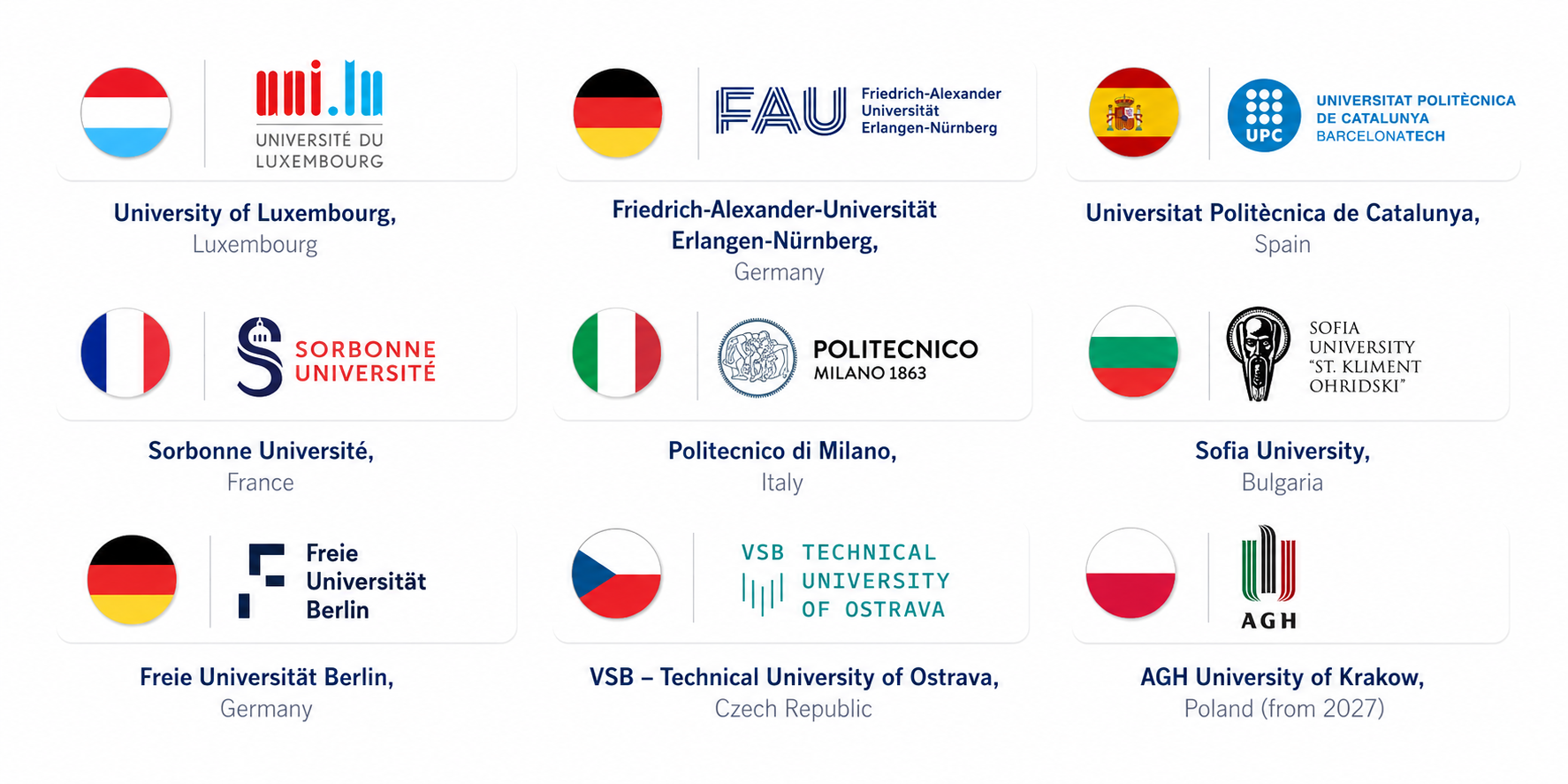
Consortium partners:
• AGH University of Krakow, Poland
• Barcelona Supercomputing Center - Centre Nacional de Supercomputació, Spain
• Consorzio Interuniversitario del Nord-Est per il Calcolo Automatico (CINECA), Italy
• Chalmers University, Sweden
• Delft University of Technology, Netherlands
• E4, Italy
• Eqanie, Spain
• European Technology Platform for High-Performance Computing (ETP4HPC), Netherlands
• EXAION, France
• Foundation for Research and Technology - Hellas (FORTH), Greece
• Freie Universität Berlin, Germany
• Friedrich-Alexander-Universität Erlangen-Nürnberg, Germany
• GE AVIO SRL, Italy
• Institute of Physics Belgrade, Serbia
• ISCTE – University Institute of Lisbon, Portugal
• LuxProvide, Luxembourg
• MathWorks, Belgium
• Middle East Technical University (METU), Turkey
• National Supercomputing Centre – Slovakia, Slovakia
• Nationales Hochleistungsrechnen Verein, Germany
• Politecnico di Milano, Italy
• Riga Technical University, Latvia
• Sofia University, Bulgaria
• Sorbonne Université, France
• SURF, Netherlands
• TERATEC, France
• Technische Universität Wien, Austria
• UCIT, France
• Università della Svizzera italiana, Switzerland
• Universitat Politècnica de Catalunya, Spain
• University of Coimbra, Portugal
• University of Evora, Portugal
• University of Galway/Irish Centre for High-End Computing, Ireland
• University of Groningen, Netherlands
• University of Ljubljana, Slovenia
• University of Luxembourg, Luxembourg
• University of Minho, Portugal
• University of Pannonia, Hungaria
• University of Reims Champagne-Ardenne, France
• University of Torino, Italy
• Verlab institute, Bosnia and Herzegovina
• VSB – Technical University of Ostrava, Czech Republic
• Zuse Institut Berlin, Germany